A Preliminary Study to Investigate Students’ and Staff Members’ Satisfactions in Using Remote Hearing Aid Finetuning Service
Remote Hearing Aid Fitting
Vol. 21 No. 1 : 2026 (145-152)

Abstract
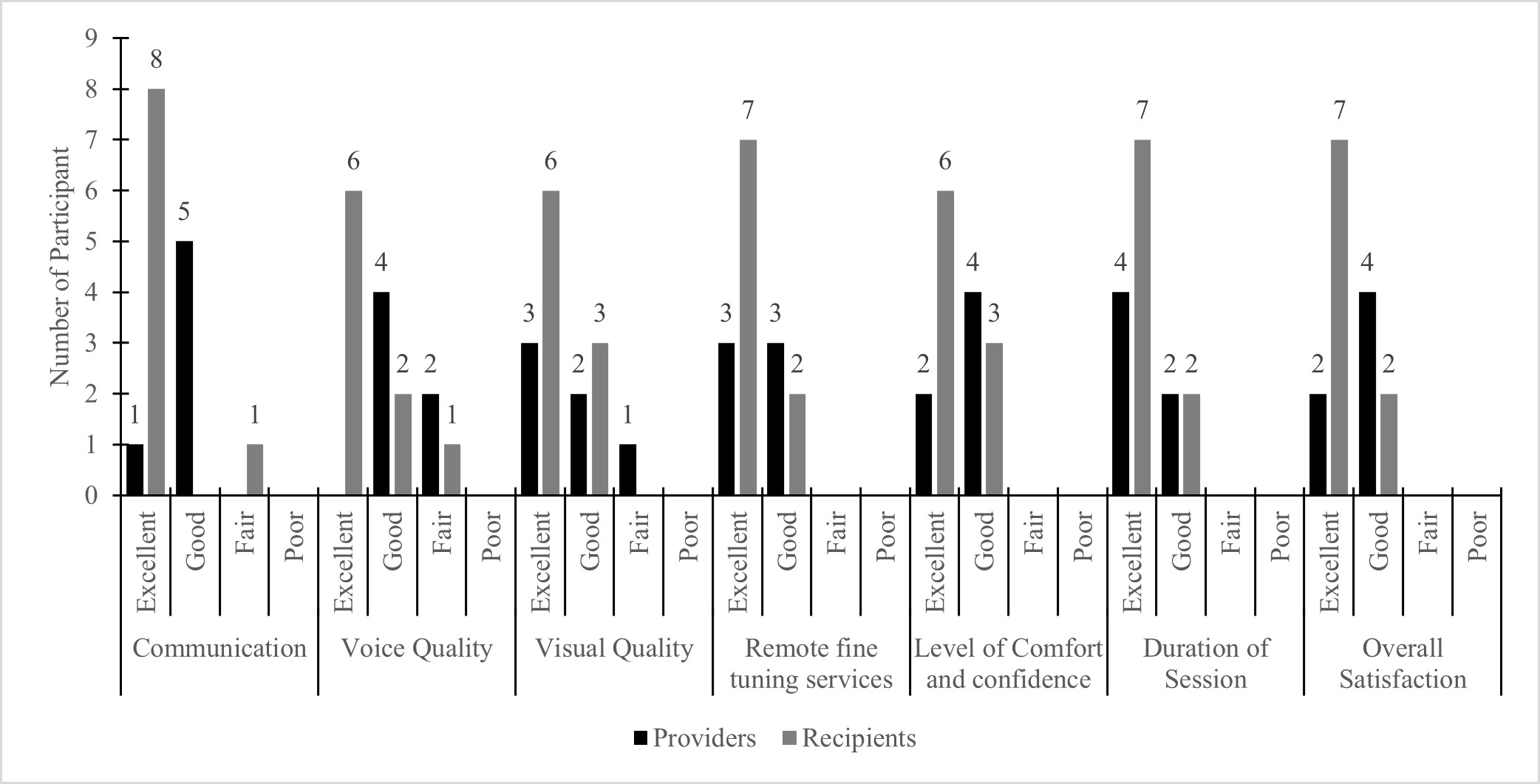
This study aimed to explore students’ and staff’s satisfaction levels in the Audiology Program of Universiti Kebangsaan Malaysia and to obtain their feedback on using remote hearing aid service. Six audiology students (service providers) were recruited to receive training on how to use the remote system. Each student was then assigned to one or more staff members (service recipients) recruited as recipients of the remote service. Nine staff members agreed to participate and were given instructions on playing the’ patient’ role. All the participants completed a survey measuring their satisfaction using the remote service. The results showed the recipients reported high satisfaction ratings, with 77.8% rating the service as excellent, while the providers provided lower satisfaction levels, with 33.3% rating it as excellent. In general, the participants were satisfied with the remote hearing aid fine-tuning service and regarded it as an alternative service that offered potential benefits. This study has provided valuable insight and helped develop useful guides for using the service.
Keywords :
Audiologist; hearing aid; remote fine-tuning; teleaudiology,
References
Campos, J., Ferrari, F. 2012. Teleaudiology: The new frontier in audiology practice. Audiol Today 24(5): 22-5.
Kochkin, S. 2005. MarkeTrak VII: Customer satisfaction with hearing instruments in the digital age. Hear J 58(9): 30-43. https://doi.org/10.1097/01.HJ.0000366912.40173.76
Novak, M., Gzella, A., Michalek, P. 2016. Telehealth and its implications for audiology: A review. J Am Acad Audiol 27(8): 659-67.
Quar, T.K., Lim, Y.F., Rashid, M.F.N., Chu, S.Y., Chong, F.Y. 2024. The influence of remote hearing aid adjustment technology on the current practice of tele-audiology among Audiologists in Malaysia. J Am Acad Audiol 35(7-8): 204-13.
Quar, T.K., Rashid, M.F.N., Rosdi, M.Y.M., Ishak, W.S., Chong, F.Y. 2023. Impact of the COVID-19 pandemic on individuals with hearing loss and audiology practice in a developing country. Am J Audio 32(1): 34-45. https://doi.org/10.1044/2022_AJA-22-00033.
Rashid, M.F.N., Quar, T.K., Chong, F.Y., Maamor, N. 2019. Are we ready for teleaudiology?: Data from Malaysia. Speech Lang Hear 23(3): 146-57. https://doi.org/10.1080/2050571X.2019.1622827.
Saunders, G.H., Chisolm, T.H., Wallhagen, M.I. 2012. Older adults and hearing help seeking behaviors. Am J Audiol 21(2): 331-7. https://doi.org/10.1044/1059‑0889(2012/12‑0028.
Thrum, M., Driscoll, C., Keogh, T. 2018. Investigating the satisfaction of clinicians and clients in a teleaudiology trial. J Hear Sci 8(4): 34-47. https://doi.org/10.17430/1003211.
World Health Organization. Hearing loss, WHO. 2024. Deafness and hearing loss. https://www.who.int [Assessed on 1 November 2024].
Zitelli, L. 2022. 20Q: Remote hearing aid programming - Getting started. Audiol Today 10(3): 15-9.