Exploring the Therapeutic Potential of Stingless Bee Honey as a Novel Therapeutic Approach for Middle Cerebral Artery Occlusion Stroke Models
Natural Products Alternative Medicine for Stroke
Vol. 21 No. 1 : 2026 (128-144)

Abstract
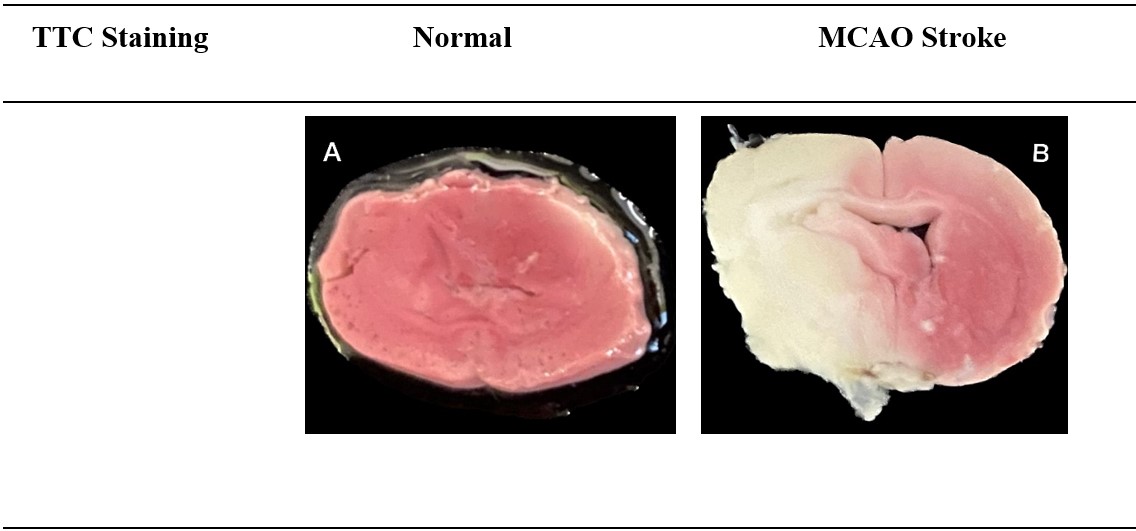
Stroke has been the leading cause of death and disability worldwide and approximately 87% of cases are attributed to ischemia. A worrying trend towards a rise in cases of stroke in an ageing population is seen and strokes have become more prevalent in Malaysia. In fact, it is predicted that Malaysia will become an ageing country by 2030 which warrants attention. In the present study, new insights on the potential neuroprotective influences of stingless bee honey (SBH) in treating middle cerebral artery occlusion (MCAO) stroke model was tested. After occluding rats with stroke via MCAO, the rats were treated with SBH for a period of 14 days. The 2,3,5-triphenyltetrazolium chloride-stained brain for ischemic stroke model showed a distinct presence of infarction confirming the reliability of MCAO method. Following confirmation, Modified Neurological Severity Score scoring was used to assess neurological deficits exhibiting a significant improvement after 14 days. Behavioural analysis encompassing cognitive and sensorimotor performance was conducted using several tests exhibiting significant positive changes. Furthermore, histological studies exhibit improved neuronal morphology, reduced neuronal loss and decreased inflammation. These studies provide encouraging results in the improvement of neurological impairments and brain tissue, highlighting the potential neuroprotective benefits of SBH in the setting of ischemic stroke.
Keywords :
Ageing country; MCAO; ischemic stroke; stingless bee honey,
Correspondance Address
Muhammad Danial Che Ramli. Department of Diagnostic and Allied Health Science, Faculty of Health and Life Sciences, Management and Science University, Off Persiaran Olahraga 40100 Shah Alam, Selangor, Malaysia. Tel: +6013 6969173 E-mail: muhddanial_cheramli@msu.edu.my
References
- Ahmed, H., Khan, M.A., Ali Zaidi, S.A., Muhammad, S. 2021. In silico and in vivo: Evaluating the therapeutic potential of kaempferol, quercetin, and catechin to treat chronic epilepsy in a rat model. Front Bioeng Biotechnol 9: 754952. https://doi.org/10.3389/fbioe.2021.754952
Al-Hatamleh, M.A.I., Boer, J.C., Wilson, K.L., Plebanski, M., Mohamud, R., Mustafa, M.Z. 2020. Antioxidant-based medicinal properties of stingless bee products: Recent progress and future directions. Biomolecules 10(6): 923. https://doi.org/10.3390/biom10060923
Azwan, N.Z., Okunsai, B., Hein, Z.M., Che Mohd Nassir, C.M.N., Che Ramli, M.D. 2025. Neuroregenerative effects of Clitoria ternatea in sciatic nerve crush injury: Morphological, morphometric, and functional analysis in rat model. Transl Res Anat 40: 100414. https://doi.org/10.1016/j.tria.2025.100414
Che Ramli, M.D., Sumari, N.A., Selamat, N.W., Muhammad, H., Sanusi, J. 2020. Effectiveness of flaxseed oil on peripheral nerve regeneration following crush injury of sciatic nerve in rat: Behavioural analysis and an electron microscopic study. Malays J Med Health Sci 16(suppl 1). 106-11.
Di Meo., S., Reed, T.T., Venditi, P., Victor, V.M. 2016. Role of ROS and RNS sources in physiological and pathological conditions. Oxid Med Cell Longev 2016: 1245049. https://doi.org/10.1155/2016/1245049
Faul, F., Erdfelder, E., Buchner, A., Lang, A.G. 2009. Statistical power analyses using G* Power 3.1: Tests for correlation and regression analyses. Behav Res Methods 41(4): 1149-60. https://doi.org/10.3758/BRM.41.4.1149
Hou, Y., Wang, K., Wan, W., Cheng, Y., Pu, X., Ye, X. 2018. Resveratrol provides neuroprotection by regulating the JAK2/STAT3/PI3K/AKT/mTOR pathway after stroke in rats. Genes Dis 5(3): 245-55. https://doi.org/10.1016/j.gendis.2018.06.001
Ja’afar, N.L., Mustapha, M., Mohamed, M., Hashim, S.A. 2024. A review of post-stroke cognitive impairment and the potential benefits of stingless bee honey supplementation. Malays J Med Sci 31(3): 75-91. https://doi.org/10.21315/mjms2024.31.3.5
Jones, T.A. 2017. Motor compensation and its effects on neural reorganization after stroke. Nat Rev Neurosci 18(5): 267-80. https://doi.org/10.1038/nrn.2017.26
Kamal, F.Z., Lefter, R., Jaber, H., Balmus, I.M., Ciobica, A., Iordache, A.C. 2023. The role of potential oxidative biomarkers in the prognosis of acute ischemic stroke and the exploration of antioxidants as possible preventive and treatment options. Int J Mol Sci 24(7): 6389. https://doi.org/10.3390/ijms24076389
Kiprono, S.J., Mengich, G., Kosgei, J., Mutai, C.., Kimoloi, S. 2022. Ethnomedicinal uses of stingless bee honey among native communities of Baringo County, Kenya. Scientific African 17: e01297. https://doi.org/10.1016/j.sciaf.2022.e01297
Koppula, S., Hemant, K., More, S.V., Byung W.K., In S.K., Dong K.C. 2012. Recent advances on the neuroprotective potential of antioxidants in experimental models of parkinson’s disease. Int J Mol Sci 13(8): 10608-29. https://doi.org/10.3390/ijms130810608
Li, J., Dai, X., Zhou, L., Li, X., Pan, D. 2021a. Edaravone plays protective effects on LPS-Induced microglia by switching M1/M2 phenotypes and regulating NLRP3 inflammasome activation. Front Pharmacol 12: 691773. https://doi.org/10.3389/fphar.2021.691773
Li, Z., Wang, H., Xiao, G., Du, H., He, S., Feng, Y., Zhang, B., Zhu, Y. 2021b. Recovery of post-stroke cognitive and motor deficiencies by Shuxuening injection via regulating hippocampal BDNF-mediated Neurotrophin/Trk Signaling. Biomed Pharmacother 141: 111828. https://doi.org/10.1016/j.biopha.2021.111828
Liu, X., Zhang, M., Liu, H., Zhu, R., He, H., Zhou, Y., Zhang, Y., Li, C., Liang, D., Zeng, Q., Huang, G. 2021. Bone marrow mesenchymal stem cell-derived exosomes attenuate cerebral ischemia-reperfusion injury-induced neuroinflammation and pyroptosis by modulating microglia M1/M2 phenotypes. Exp Neurol 341: 113700. https://doi.org/ 10.1016/j.expneurol.2021.113700
Long, X., Yao, X., Jiang, Q., Yang, Y., He, X., Tian, W., Zhao, K., Zhang, H. 2020. Astrocyte-derived exosomes enriched with miR-873a-5p inhibit neuroinflammation via microglia phenotype modulation after traumatic brain injury. J Neuroinflammation 17(1): 89. https://doi.org/10.1186/s12974-020-01761-0
Luo, L., Li, C., Du, X., Shi, Q., Huang, Q., Xu, X., Wang, Q. 2019. Effect of aerobic exercise on BDNF/proBDNF expression in the ischemic hippocampus and depression recovery of rats after stroke. Behav Brain Res 362: 323-31. https://doi.org/10.1016/j.bbr.2018.11.037
Mitjavila, M.T., Moreno, J.J. 2012. The effects of polyphenols on oxidative stress and the arachidonic acid cascade. Implications for the prevention/treatment of high prevalence diseases. Biochem Pharmacol 84(9): 1113-22. https://doi.org/10.1016/j.bcp.2012.07.017
Morris, G.P., Wright, A.L., Tan, R.P., Gladbach, A., Ittner, L.M., Vissel, B. 2016. A comparative study of variables influencing ischemic injury in the longa and koizumi methods of intraluminal filament middle cerebral artery occlusion in mice. PLoS One 11(2): e0148503. https://doi.org/10.1371/journal.pone.0148503
Ooi, T.C., Yaacob, M., Rajab, N.F., Shahar, S., Sharif, R. 2021. The stingless bee honey protects against hydrogen peroxide-induced oxidative damage and lipopolysaccharide-induced inflammation in vitro. Saudi J Biol Sci 28(5): 2987-94. https://doi.org/10.1016/j.sjbs.2021.02.039
Pakaprot, N., Khampaya, T., Kwankaew, P., Ninsuwan, S., Laisunthad, S., Thonoi, K., Kuraeiad, S. 2024. Neuroprotective effects of paederia foetida Linn. on scopolamine-induced cognitive impairment in rats. Vet World 17(9): 1972-82. https://doi.org/10.14202/vetworld.2024.1972-1982
Pimentel, T.C., Rosset, M., Sousa, J.M.B., Oliveira, L.I.G., Mafaldo, I.M., Pintado, M.M.E., Souza, E.L., Magnani, M. 2022. Stingless bee honey: An overview of health benefits and main market challenges. J Food Biochem 46(3): e13883. https://doi.org/10.1111/jfbc.13883
Sardooi, A.R., Reisi, P., Yazdi, A. 2020. Protective effect of honey on learning and memory impairment, depression and neurodegeneration induced by chronic unpredictable mild stress. Physiol Pharmacol 25(1): 21-35. http://dx.doi.org/10.32598/ppj.25.1.90
Shaikh, A., Ahmad, F., Teoh, S.L., Kumar, J., Yahaya, M.F. 2024. Unveiling the therapeutic potential of kelulut (stingless bee) honey in Alzheimer’s disease: Findings from a rat model study. Antioxidants 13(8): 926. https://doi.org/10.3390/antiox13080926
Shen, H., Wu, X., Zhu, Y., Sun, H. 2013. Intravenous administration of achyranthes bidentata polypeptides supports recovery from experimental ischemic stroke in vivo. PLoS One 8(2): e57055. https://doi.org/10.1371/journal.pone.0057055
Shi, G., Feng, J., Jian, L.Y., Fan, X.Y. 2023. DNA hypomethylation promotes learning and memory recovery in a rat model of cerebral ischemia/reperfusion injury. Neural Regen Res 18(4): 863-8. https://doi.org/10.4103/1673-5374.353494
Shi, X., Bai, H., Wang, J., Wang, J., Huang, L., He, M., Zheng, X., Duan, Z., Chen, D., Zhang, J., Chen, X., Wang, J. 2021. Behavioral assessment of sensory, motor, emotion, and cognition in rodent models of intracerebral hemorrhage. Front Neurol 12: 667511. https://doi.org/10.3389/fneur.2021.667511
Tao, T., Liu, M., Chen, M., Luo, Y., Wang, C., Xu, T., Jiang, Y., Guo, Y., Zhang, J.H. 2020. Natural medicine in neuroprotection for ischemic stroke: Challenges and prospective. Pharmacol Ther 216: 107695. https://doi.org/10.1016/j.pharmthera.2020.107695
Umbar, G.S.A., Mohamed Kasturi, F.E., Li, A.R., Zainul Abidin, N.H.K., Muhammad, H., Jazuli, I., Kumari, Y., Zulkapli, A., Che Ramli, M.D. 2024. Therapeutic potential of alkaloid-rich mitragyna speciosa extract in mptp-induced zebrafish parkinson’s disease model. Med Health 20(2): 510-24. https://doi.org/10.17576/MH.2025.2002.06
Xu, L., Gao, Y., Hu, M., Dong, Y., Xu, J., Zhang, J., Lv, P. 2022. Edaravone dexborneol protects cerebral ischemia reperfusion injury through activating Nrf2/HO‐1 signaling pathway in mice. Fundam Clin Pharmacol 36(5): 790-800. https://doi.org/10.1111/fcp.12782
Yao, X., Yang, W., Ren, Z., Zhang, H., Shi, D., Li, Y., Yu, Z., Guo, Q., Yang, G., Gu, Y., Zhao, H., Ren, K. 2021. Neuroprotective and angiogenesis effects of levetiracetam following ischemic stroke in rats. Front Pharmacol 12: 638209. https://doi.org/10.3389/fphar.2021.638209
Yu, L., Zhang, Y., Chen, Q., He, Y., Zhou, H., Wan, H., Yang, J. 2022. Formononetin protects against inflammation associated with cerebral ischemia-reperfusion injury in rats by targeting the JAK2/STAT3 signaling pathway. Biomed Pharmacother 149: 112836. https://doi.org/10.1016/j.biopha.2022.112836
Zhang, L., Li, X., Wolfe, C.D., O’Connell, M.D., Wang, Y. 2021. Diabetes as an independent risk factor for stroke recurrence in ischemic stroke patients: an updated meta-analysis. Neuroepidemiology 55(6): 427-35. https://doi.org/10.1159/000519327
Zhou, R, Yang, Z., Tang, X., Tan, Y., Wu, X. Liu, F. 2013. Propofol protects against focal cerebral ischemia via inhibition of microglia-mediated proinflammatory cytokines in a rat model of experimental stroke. PLoS One 8(12): e82729. https://doi.org/10.1371/journal.pone.0082729
Zhu, T., Wang, L., Feng, Y., Sun, G., Sun, X. 2021. Classical active ingredients and extracts of Chinese herbal medicines: Pharmacokinetics, pharmacodynamics, and molecular mechanisms for ischemic stroke. Oxid Med Cell Longev 2021: 8868941. https://doi.org/10.1155/2021/8868941
Zlatanova, H.I., Georgieva-Kotetarova, M.T., Vilmosh, N.B., Kandilarov, I.K. 2022. Evaluation of the effect of cariprazine on memory and cognition in experimental rodent models. Int J Environ Res Public Health 19(22): 14748. https://doi.org/10.3390/ijerph192214748
Zulkifli, N.A., Hassan, Z., Mustafa, M. Z., Azman, W. N.W., Hadie, S.N.H., Ghani, N., Mat Zin, A.A. 2023. The potential neuroprotective effects of stingless bee honey. Front Aging Neurosci 14: 1048028. https://doi.org/10.3389/fnagi.2022.1048028