Effectiveness of Focal Vibration on Muscle Tone, Kinematic Parameters, and Motor Function in Individuals with Stroke, Parkinson’ Disease and Multiple Sclerosis: A Systematic Review, Meta-Analysis and Meta-Regression
Focal Vibration in Neurological Disorders
Abstract
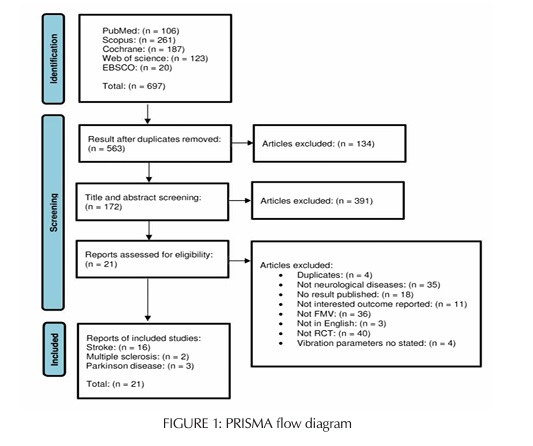
This systematic review aimed to investigate the effect of focal vibration (FV) on muscle tone, kinematic parameters and motor functions in individuals with stroke, Parkinson’ disease and multiple sclerosis. It also determined the influence of vibration parameters such as frequency and amplitude, stimulation session duration, and the total number of intervention sessions on the outcome measures. PubMed, Scopus, Cochrane, Web of Science, and EBSCO were searched, yielding 21 qualifying articles. Within a week post-treatment, FV effectively reduced elbow spasticity (P = 0.04), improved upper limb kinematic parameters (SMD = -0.75, 95% CI: -1.50 to -0.01), and enhanced upper limb motor function (P = 0.05) in stroke patients. FV significantly improved lower limb kinematic parameters of Parkinson’s disease patients (P = 0.03). Over a week post-treatment, the effect of FV was not significant in reducing spasticity for upper limb in stroke (P = 0.25) and improving kinematic parameters for lower limb in Parkinson’s disease (SMD = 0.38, 95% CI: -0.58 to 1.35). The total therapy sessions significantly associated with the effect size (p = 0.042) for upper limb motor function outcome measure. Conclusion, integrating FV into rehabilitation may benefit patients with neurological disorders such as stroke, Parkinson’s disease, and multiple sclerosis.
Keywords :
Nervous system diseases,
systematic review,
vibration,
Correspondance Address
Muhammad Fauzinizam Razali. Neurorehabilitation Engineering and Assistance Systems Research, School of Mechanical Engineering, Universiti Sains Malaysia Engineering Campus, Jln Transkrian - Bukit Panchor, 14300 Nibong Tebal, Pulau Pinang, Malaysia. Tel: +6016-28264082 Email: mefauzinizam@usm.my